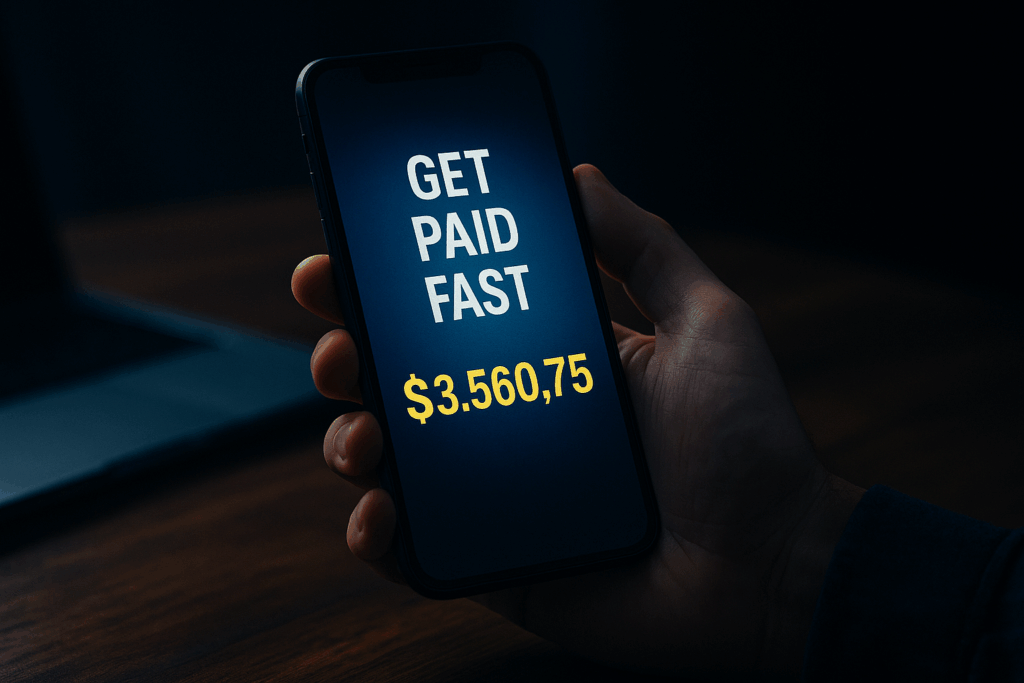
They promise you will get paid fast. They tell you they will compare your claim with thousands nationwide. But the only thing really being compared is the price tag on your personal information.
Across social media, a wave of so-called “settlement calculator” apps has exploded. Sleek designs, catchy names, and too-good-to-be-true promises lure people in. They claim to estimate your settlement instantly, connect you with top lawyers, or even get you paid just by downloading the app.
Freddie Fender Investigations decided to dig deeper. What we found paints a very different picture.
Behind the Screens
Most of these apps follow the same playbook.
Step one: attract desperate or curious users with promises of instant results.
Step two: ask for personal details such as name, phone number, zip code, and details about your accident.
Step three: sell that data.
That is right. The app is not built to get you paid. It is built to get paid off you.
Industry insiders call this lead generation. It is the practice of gathering personal information and auctioning it to marketers, call centers, or law firms who pay top dollar for potential clients. Your “free estimate” becomes a digital lottery ticket traded to the highest bidder.
The Business of Data
A typical lead in the personal injury or legal space can sell for anywhere from fifty dollars to over five hundred dollars depending on how “hot” it looks. Some apps even resell the same lead multiple times. That is why people often report a flood of calls and texts within hours of entering their information.
“I thought I was getting a free settlement estimate,” one California driver told us. “Within a day, I had four different lawyers calling me. None of them knew who the others were.”
When Freddie Fender reached out to several app developers for comment, few responded. One marketing firm admitted off record that their “claim calculator” was simply a front-end funnel.
“We never said we pay users,” the representative said. “We just say we help them get paid faster. There is a difference.”
The Psychology of the Pitch
These companies use the same persuasion triggers found in high-pressure sales funnels.
- Urgency: “Time is running out to claim your money.”
- Authority: “Trusted by thousands nationwide.”
- Social proof: fake reviews or stock images showing smiling people who “got paid.”
When users see the words “nationwide network” or “verified experts,” it gives the illusion of legitimacy even if the only thing verified is your email address.
What Really Happens Next
Once you hit submit, your information is uploaded to a broker’s dashboard. From there, it is distributed to multiple buyers who compete to contact you first. Every time your phone rings, someone is trying to cash in on your click.
Even worse, your data may not stop there. In some cases, it is passed downstream to other vendors, creating an endless loop of spam calls, marketing emails, and fraudulent offers pretending to “follow up” on your claim.
Meanwhile, the app continues collecting. Every click, every form, every tap. Data is the real goldmine.
Why It Matters
Aside from being misleading, these tactics exploit people at their most vulnerable. Someone recovering from an accident might think they are finding legal help when, in reality, they have just entered a digital auction.
Consumer protection experts warn that while lead generation itself is not illegal, misrepresentation is. If an app claims you will “get paid fast” but has no mechanism to do so, it crosses the line from clever marketing into deception.
How to Spot a Scam Calculator
- The app promises instant cash or guaranteed settlement results.
- You must enter personal details before seeing any result.
- The estimate you get is vague, like “You could be owed up to X dollars.”
- The privacy policy allows data sharing or third-party marketing.
- You get multiple calls or texts from different companies afterward.
If you see one of these signs, back out immediately.
Freddie’s Final Word
At Freddie Fender, we believe the truth deserves a microphone.
These apps do not exist to pay you. They exist because you pay them with your privacy, your peace of mind, and your trust.
So the next time a flashy ad tells you to “Get paid fast,” ask one simple question:
Who is really getting paid here?
Stay sharp. Stay protected.
And remember, the name to trust is not the one shouting in your feed.
It is the one telling you the truth.
Freddie Fender Investigations
The Legendary Network That Gets You Help, Not Hustled.