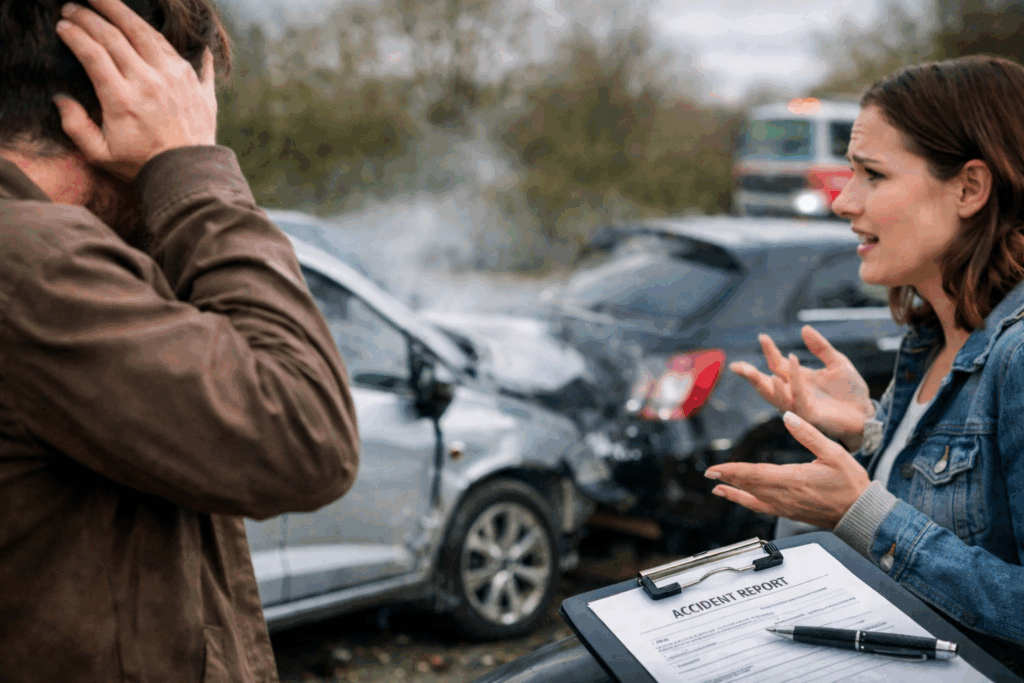
Car accidents are disorienting, even minor ones.
In the moments after a crash, your heart races and your hands shake. At the same time, people start talking to you. You are trying to understand what just happened while processing shock, noise, and confusion.
Because of that stress, most drivers are not thinking about insurance claims or long-term consequences. Instead, they focus on being polite, calming the situation, and moving on as quickly as possible.
Unfortunately, the words that come out in those first few minutes can quietly follow you for months.
What you say after a crash does not disappear once the scene clears. Instead, it often becomes part of police reports, insurance files, medical notes, and recorded calls. Some of the most common phrases drivers use are later taken out of context and used to reduce or deny claims.
Why Words Matter More Than People Expect
After a crash, insurers build a timeline.
They review police reports, witness statements, recorded calls, and medical records. In addition, they examine your own words closely. Insurers treat those statements as evidence, even when they were made casually or under stress.
For that reason, offhand comments can later be framed as admissions, inconsistencies, or proof that injuries were not serious. This does not mean you should be silent. However, it does mean you should be careful.
“I’m Fine”
This is one of the most common things drivers say after a crash.
Usually, people mean it socially, not medically. They are trying to reassure others or avoid attention. However, insurers often take this statement literally.
Later, when pain appears or injuries are diagnosed, adjusters may argue that you already admitted you were not hurt. Adrenaline often masks symptoms for hours or even days, but that reality is rarely reflected in claim files.
If you are unsure how you feel, it is better to say you need medical evaluation.
“I’m Sorry”
Apologies are instinctive. Many drivers apologize even when they did nothing wrong.
Unfortunately, insurers often treat apologies as admissions of fault. In claim reviews, a simple “I’m sorry” can be framed as accepting responsibility. As a result, fault disputes become more complicated than they need to be.
You can remain respectful without apologizing. Courtesy does not require accepting blame.
“I Didn’t See You”
This phrase comes up often, especially in intersection and lane-change crashes.
Most drivers mean they were surprised. However, insurers may take this statement as an admission that you failed to keep a proper lookout. Even when the other driver caused the collision, this phrase can shift attention onto you.
If you do not know exactly what happened, it is okay to say that.
“It’s Probably My Fault”
Shock causes people to second-guess themselves.
Before reviewing evidence or understanding traffic signals, drivers sometimes assign blame to themselves. Fault, however, is a legal determination. You do not need to decide it on the roadside.
Speculating about responsibility can quietly damage a claim, especially when later evidence tells a different story.
“It’s Not That Bad”
Many people downplay crashes to keep things calm.
In reality, minimizing damage or injuries can backfire. Insurers often argue that minor crashes cannot cause serious injuries. They rely on these early comments even when medical records later show otherwise.
Modern vehicles absorb impact in ways that protect occupants while still causing real physical trauma.
Joking or Laughing It Off
Nervous humor is a common response to stress.
However, witnesses or reports may note that you appeared unconcerned. Later, insurers sometimes use that observation to question injury claims. Emotional reactions do not reflect physical injuries, but claim files rarely include that context.
Oversharing Details You Are Unsure About
Memory is unreliable after trauma.
Because of that, guessing about speed, distance, or timing can cause problems later. When details change, insurers may point to those differences as inconsistencies.
Instead, stick to what you know for certain. Avoid speculation when you are unsure.
Talking Too Freely to Insurance Adjusters
Adjusters often sound friendly and supportive.
Early calls are usually recorded, though. Questions may feel casual, but insurers use them to evaluate claims. You are allowed to take time, review information, and keep responses factual.
You do not need to provide a full narrative while still processing the crash.
What You Can Say Instead
You do not need a script. You just need boundaries.
You can say:
I need medical evaluation before discussing injuries
I am still gathering information
I am not sure yet
I will follow up after reviewing the report
Clear, limited communication protects you without creating conflict.
The Goal Is Not Silence, It Is Clarity
Being careful with words is not about hiding information.
Instead, it helps prevent assumptions, speculation, and statements made under stress. Strong claims rely on documentation, medical records, and clear facts, not roadside conversations.
Freddie’s Final Word
After a crash, most drivers are simply trying to do the right thing. They want to be polite, calm the situation, and move forward. What many do not realize is that a few casual words can quietly shape everything that comes next. You do not need to argue or accuse anyone. You only need to slow down and choose your words carefully. Freddie Fender is here to help drivers understand the moments that matter and navigate them with clarity and confidence.
Freddie Fender Investigations
Where clarity replaces confusion and real help gets delivered.